


Contact Us
Wheelchair Foot Boxes: Types, Uses & Buying Overview
When a wheelchair user can’t keep their own feet on the footplate — because of high muscle tone, a stroke, advanced dementia or fragile skin — the feet slide, roll, kick off or press against hard metal. A wheelchair foot box is the positioning accessory built to solve that: an enclosure that contains, cushions and aligns the feet and lower legs on the chair.
But “foot box” is an umbrella term, not a single product. There are soft-padded and rigid-shell versions, single and double designs, models with leg dividers, gel linings, heel cut-outs and adjustable angles — at prices from under a hundred dollars to several hundred per pair. This overview maps the whole category: the types, how they compare to other foot supports, what to look for, what they cost (including the US insurance code), and how to choose the right one.
It’s written for caregivers, care-home and long-term-care teams, occupational and physiotherapists, families, and procurement buyers. For a deep dive on one specific subtype — the most common one — we link down to our complete guide to soft padded wheelchair footboxes throughout.
Quick takeaways
A foot box is a foot-enclosing positioning accessory that mounts to the footplate and holds the feet in a safe, supported position.
The main split is soft-padded foam (comfort, skin protection) vs. rigid/semi-rigid shell (durability, impact protection, strong involuntary movement).
Other choices: single vs. double, with or without a leg divider, foam vs. gel, heel cut-out, and fixed vs. angle-adjustable.
A foot box is one of several foot supports — it’s the option that combines positioning, containment and cushioning in one device.
In the US it’s billed under HCPCS E0954 (per foot); coverage depends on documented medical need.
Always involve an occupational therapist or physiotherapist — foot-positioning needs are individual.
What is a wheelchair foot box?
A wheelchair foot box (also “footbox” or “foot positioning box”) is a cushioned or shelled enclosure that surrounds the feet on a wheelchair, mounting onto or across the footplates. Instead of resting on a bare plate, the feet sit inside walls that keep them aligned, contained and protected through long periods of sitting.
It’s easy to confuse the foot box with neighbouring devices, so it helps to pin down the terms:
-
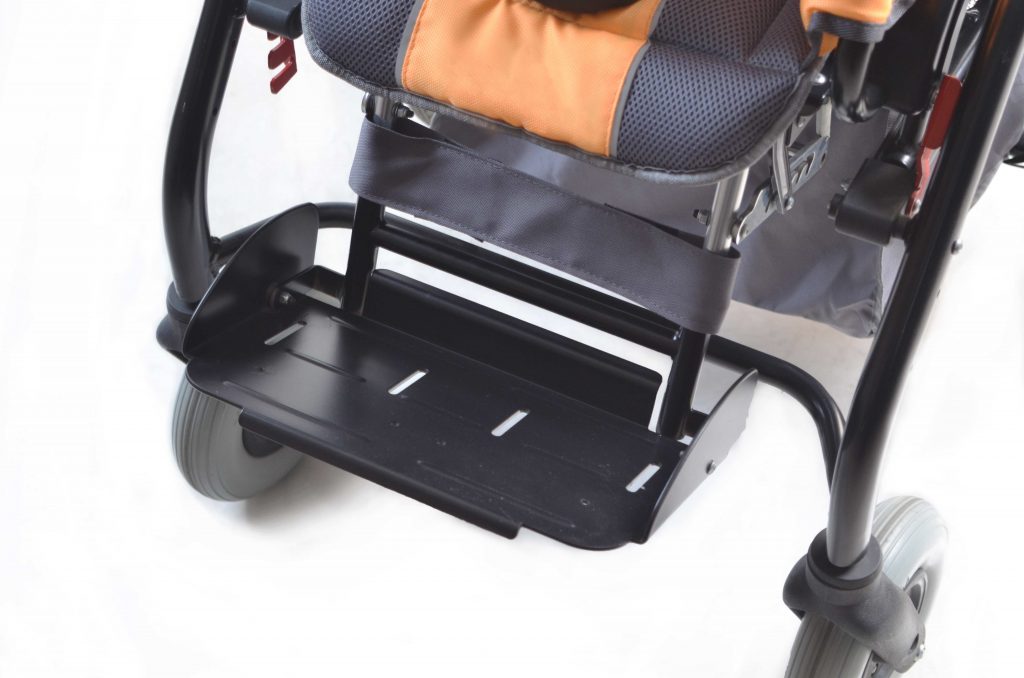
Footplate / footrest — the flat platform the feet rest on, and the base a foot box mounts to. Not a positioning device on its own.
-
Foot box — adds enclosing walls for containment, cushioning and alignment. The subject of this guide.
-
Foot positioner / foot cradle — a softer, often open accessory that holds the feet without fully enclosing them (e.g., contoured foam cradles). Overlaps with foot boxes but is usually less containing.
-
Positioning straps and heel loops — webbing that holds feet onto the plate, with no cushioning or wall.
In a seating setup, the foot box sits at the bottom of the support chain — seat and cushion, then back support, then lower-extremity support, then the foot box refining how the feet are held.
Who needs a foot box? Signs and indications
A foot box is most useful for people who sit for long periods and cannot reposition their own feet. Common signs and conditions include:
-
Feet that slip, roll inward or kick off the footplate
-
Foot drop after stroke or with neurological conditions (the foot can’t lift and hangs or drags)
-
Spasticity / high muscle tone and involuntary movement, including scissoring (legs crossing toward the midline)
-
Contractures — joints settling into a fixed, shortened position over time
-
Heel pressure-injury risk in users who can’t shift their own weight
-
Frailty and swelling (edema), where skin is fragile and feet are heavy to position
It’s common in care homes and long-term care, but just as relevant for families supporting someone at home. We cover the clinical reasoning — positioning, foot drop, contracture and pressure-injury prevention — in depth in our soft-padded footbox guide; this overview keeps it brief and focuses on the equipment itself. (For the condition itself, the NHS foot drop page is a good plain-English primer.)
Types of wheelchair foot boxes
This is the heart of the category. Foot boxes vary along several independent axes — construction, configuration, materials and features — and most real products mix and match them.
By construction: soft-padded vs. rigid shell
-
Soft-sided / foam foot box. Walls and base made of supportive foam in a washable cover. The most common type — comfortable, skin-friendly, easy to store, and well suited to pressure-injury and positioning needs. This is the subtype covered in detail in our soft padded wheelchair footboxes guide.
-
Rigid / semi-rigid shell foot box. A firm outer shell — typically ABS plastic or an aluminium frame with padded edges. It holds shape against strong pushing, bounces back after impact, and shields the feet from door frames and obstacles. Best for users with powerful involuntary movement, or where durability in heavy daily use matters more than softness.
By configuration
-
Single foot box — one open compartment for both feet (roomy, simple) or a box sized for a single foot.
-
Double / full foot box — supports both feet across the footplates.
-
With a leg divider (centre separator) — a padded post between the feet that keeps the legs apart and resists inward rolling and scissoring. Choose this when the user’s feet or knees collapse toward the midline.
-
Split foot box — independent left and right halves that can move with swing-away or separately mounted footplates.
By materials
-
Foam — the standard cushioning.
-
Gel-lined — a gel layer that further reduces pressure, shear and heat buildup; useful for high skin-breakdown risk.
-
Fleece or wipe-clean vinyl covers — fleece for comfort, wipe-clean antimicrobial fabric for infection control in shared settings.
By height and feature set
-
Standard vs. tall — taller boxes (roughly 12″ vs. a standard 8″) add calf containment for users who need their lower legs held too.
-
Heel cut-out / heel relief — a recess that offloads pressure from the back of the heel, a frequent pressure-injury site.
-
Fixed vs. angle-adjustable — basic boxes hold one angle; advanced models adjust to match the user’s available ankle range. The Comfort Company’s Flexion Footbox, for example, adjusts from 90° to 160° with a single screw.
Key features and add-ons explained
When you compare specific models, these are the features that change the clinical result:
|
Feature |
What it does |
Choose it when |
|---|---|---|
|
Heel cut-out |
Removes contact under the heel to offload pressure |
Heel pressure-injury risk; reduced sensation |
|
Leg divider / separator |
Keeps feet and knees apart, controls scissoring |
Legs collapse or cross toward the midline |
|
Angle adjustability (e.g., 90–160°) |
Matches the box to the user’s ankle range |
Limited dorsiflexion, contracture management |
|
Gel lining |
Cuts pressure, shear and heat vs. foam alone |
Fragile skin, long sitting times |
|
Plantar/dorsal wedges |
Fine-tune foot rotation and position |
Foot turns in/out, deformity risk |
|
Removable washable cover |
Hygiene and infection control |
Care homes, shared or incontinent use |
|
Rigid ABS shell |
Durability and impact protection |
Strong tone, door-frame knocks, heavy use |
Foot box vs. other foot-support options
A foot box is one tool among several. The right answer is often a combination, guided by a therapist — but here’s where each fits:
|
Option |
What it does |
Best for |
Limitations |
|---|---|---|---|
|
Foot box (soft or rigid) |
Encloses, cushions and positions the feet and lower legs |
Can’t reposition feet; foot drop, spasticity, skin-protection, scissoring |
Bulkier; needs correct sizing and mounting |
|
Foot cradle / positioner |
Contours and holds feet without fully enclosing |
Milder positioning needs; some self-control |
Less containment than a box |
|
Positioning straps / ankle straps |
Hold feet onto the plate; control rotation |
Mild slipping; users with some control |
No cushioning or skin protection |
|
Heel loops |
Stop the heel sliding backward off the plate |
Backward slip only |
No positioning or pressure relief |
|
Calf pads / straps |
Support the lower leg |
Lower-leg support alongside foot positioning |
Doesn’t contain the feet |
|
Elevating legrests |
Raise and extend the lower leg |
Edema, circulation, post-surgery |
Changes seated angle; not a containment device |
|
AFO (ankle-foot orthosis) |
Brace worn on the body to hold the foot |
Foot drop, worn in and out of the chair |
A worn orthotic, not a chair accessory |
The distinction that matters: straps and heel loops solve slipping, legrests solve elevation, an AFO is worn on the body — but only a foot box combines positioning, containment and cushioning in one device mounted to the chair.
Sizing and mounting basics
Two things decide whether a foot box works on a given chair: size and mounting.
-
Width typically follows the wheelchair’s seat width (16″ and 18″ are common), so the box spans the footplates correctly.
-
Depth/height — standard boxes contain the feet; tall boxes add calf support. Match this to how much of the lower leg needs holding.
-
Mounting is usually a slotted base that bolts across the footplates (firm, with fore/aft adjustment), or a strap/hook-and-loop attachment that allows legrests to swing away for transfers.
-
Compatibility — confirm it suits your footplate type and whether your legrests are fixed, swing-away or elevating.
A box that’s too big lets the feet slide; too small forces them into a cramped, harmful position. For the detailed measuring walkthrough — foot length and width, lower-leg depth, ankle angle — see the soft padded footbox guide, and have an OT or PT confirm the fit, especially where contractures or skin damage are involved.
Top brands and models compared
The foot-box market is served by a handful of specialist seating manufacturers. This neutral snapshot helps you know what to look for — availability varies by country and supplier.
|
Brand |
Representative models |
Type(s) |
Notable features |
|---|---|---|---|
|
JAY / Sunrise Medical |
JAY Foot Box (Single, Full, Full with Divider) |
Soft-padded |
Single/full/divider options, optional gel |
|
The Comfort Company / Permobil |
Comfort Foot Single / Double / Double Tall; Flexion Footbox |
Soft-padded (Comfort Foot); padded aluminium shell / semi-rigid (Flexion) |
Heel cut-out, leg separator, 90–160° angle adjust, optional gel & wedges |
|
Therafin |
ABS Footbox; Padded Full; Padded ABS Split |
Rigid ABS + padded; single, full or split |
Rigid shell that bounces back after impact; flexible and rigid options |
|
GelOvations |
Angle-adjustable gel foot boxes |
Gel-lined aluminium shell (semi-rigid) |
Gel cushioning, single/dual angle adjust |
|
Etac |
Soft-padded |
Lightweight UK/EU option for Etac chairs |
A note on “related” brands. You’ll also see Bodypoint (Ankle Huggers, Toe Straps), Drive Medical (heel loops) and gel foot straps. These are genuine, useful foot-support products — but they’re straps and loops, not foot boxes. Treat them as complementary devices, not alternatives in the same category. Likewise, a foot cradle (e.g., from Skil-Care) is a related positioner, not a full enclosing box.
Cost, funding and insurance (HCPCS E0954)
Foot boxes range from roughly $80 to $400+ each, depending on construction (rigid and gel-lined cost more), brand and features like angle adjustment.
In the United States, a wheelchair foot box has its own billing code. The official HCPCS descriptor for E0954 is:
“Wheelchair accessory, foot box, any type, includes attachment and mounting hardware, each foot.”
Two things matter in that wording. First, “any type” means the code covers both soft and rigid boxes. Second, “each foot” means it’s billed per foot — a double setup is two units. A billing code is not a coverage guarantee, though: as durable medical equipment, funding depends on documented medical necessity (foot drop, contracture, positioning need) and your specific plan. Outside the US, funding runs through different pathways — the NHS in the UK, NDIS in Australia, provincial programs in Canada — so check with your local provider or supplier.
For care homes and distributors sourcing at scale, the practical priorities are durable wipe-clean covers, consistent supply for replacements, and foot-support that’s configurable across a mixed wheelchair fleet.
How to choose the right foot box
Work the decision from the user’s needs, in this order:
-
Soft or rigid? Strong involuntary movement, impact risk or heavy daily use → rigid shell. Comfort, skin protection and most positioning needs → soft-padded.
-
Single, double or divider? Legs that roll or cross toward the midline → a double box with a divider. Otherwise a single or plain double.
-
Which features? Heel pressure risk → heel cut-out (and consider gel). Limited ankle range or contracture → angle-adjustable. Feet that rotate → wedges.
-
Size and mounting to the chair — width, height, and a secure footplate fit.
-
Hygiene — a removable washable cover for any shared or care-home use.
-
Get it assessed. Because range of motion and skin tolerance are individual, an occupational therapist or physiotherapist should sign off the choice and fit — especially with contractures, spasticity or existing skin damage.
Start with the wheelchair’s own foot support
A foot box sits on top of — and depends on — the chair’s foot-support system. The best results come when the wheelchair already provides adjustable, well-engineered foot support as the foundation, so the box only has to refine it.
This is where the base chair matters. Wheelchairs built for comfort and long-term seating offer height- and angle-adjustable footplates, swing-away or detachable footrests, and elevating legrests. INTCO Medical’s comfort and reclining wheelchairs are designed around this — the RECLINER (Y202) pairs an elevating legrest with an adjustable, heel-supporting footplate, while the COMFORT model uses a swing-away footrest for easier transfers. For complete seated pressure care, foot support also works with the seat: a properly specified seat cushion distributes pressure under the pelvis while the foot box protects the feet.
As a manufacturer supplying wheelchairs and seating to 150+ countries, INTCO Medical works with healthcare buyers and distributors on custom foot-support and positioning configurations built into the wheelchair itself through its OEM/ODM solutions. If you need wheelchairs specified for dependent or high-positioning-need users, talk to our team about the right setup.
The bottom line
A wheelchair foot box is a small accessory that solves a real problem for users who can’t keep their own feet in position. The category spans soft-padded and rigid-shell builds, single and double layouts, dividers, gel linings, heel cut-outs and adjustable angles — so the right choice comes down to matching construction and features to the user’s needs, sizing it to the chair, and having a therapist confirm the fit.
If the soft-padded type is what you’re considering, our complete guide to soft padded wheelchair footboxes covers the clinical reasoning, measuring and fitting in detail. And remember that the best foot support starts with the wheelchair itself: a well-engineered, adjustable foot-support system is the foundation every foot box builds on.
INTCO Medical has manufactured wheelchairs and seating solutions for over 30 years, supplying comfort, reclining and positioning-focused mobility products to healthcare providers in 150+ countries. INTCO does not sell a standalone foot box; for wheelchairs configured for dependent and high-positioning-need users, get in touch with our team.
This article is general guidance, not medical advice. Foot-positioning and pressure-care needs are individual — always consult a qualified occupational therapist, physiotherapist or clinician before selecting or fitting foot-support equipment.
Frequently asked questions
What is a wheelchair foot box used for?
It contains, cushions and positions a user’s feet on the wheelchair — holding them in a safe position, protecting the heels and lower legs, and stopping feet from slipping or kicking off the footplate.
What’s the difference between a foot box and a footplate?
A footplate is the flat platform the feet rest on. A foot box adds enclosing walls that contain and cushion the feet — it mounts onto or across the footplate.
Soft or rigid foot box — which is better?
Soft-padded boxes are more comfortable and skin-friendly and suit most users. Rigid ABS-shell boxes are more durable, protect against impacts, and hold up to strong involuntary movement. Many users do best with soft; choose rigid for high tone or heavy-duty protection.
What is a foot box with a divider for?
The padded centre divider keeps the feet and knees apart, controlling legs that roll inward or cross (scissoring) and promoting midline alignment.
Is a wheelchair foot box covered by insurance?
In the US it has its own HCPCS code, E0954, billed per foot — but a code isn’t a coverage guarantee. Funding depends on documented medical necessity and your plan. Outside the US, coverage runs through national or regional schemes.
Foot box, foot cradle or positioning straps — what’s the difference?
A foot box fully encloses and cushions the feet; a foot cradle contours and holds them more openly; straps and heel loops simply keep feet on the plate without cushioning. Choose by how much containment and skin protection the user needs.
How does a foot box attach to the wheelchair?
Usually a slotted base that bolts across the footplates, or a strap/hook-and-loop mount. Confirm compatibility with your footplate and whether your legrests are fixed, swing-away or elevating.