


Contact Us
All-Terrain Wheelchair Tires: How to Choose by Terrain
The wrong tires turn a gravel path into a wrestling match and a grass lawn into a dead stop. The right ones let you push across a beach boardwalk, a forest trail or a snowy sidewalk with effort you can actually sustain. Yet most advice online stops at “get knobby tires” — without telling you which knobs, at what pressure, in what size, for your surfaces.
This guide fixes that. It walks through the three tire constructions that matter, the tread patterns that grip, and the sizing details that decide whether a tire even fits your chair — then ties them together in a terrain-by-terrain matching matrix and a cross-model spec table you can buy from. It also covers the part other guides skip: when switching tires is the wrong move, and when you need new wheels, or a different chair entirely.
Quick takeaways
Construction first: pneumatic (air) tires give the best traction and cushioning off-road; solid tires are flat-free but wrong for soft ground; foam-filled sit in between.
Tread follows terrain: knobby for mud, sand, snow and loose trail; semi-slick for mixed urban-trail use; slick/ribbed for mostly-pavement.
Width and low pressure create “float” — the key to sand and snow. Narrow, hard tires dig in and sink.
Size is non-negotiable: match the bead-seat diameter (the ISO/ETRTO number), not just the “24 inch” label, or the tire won’t fit.
Expect roughly $40–150 per tire for quality all-terrain rubber; fat/balloon wheel sets and full off-road chairs are different budget tiers.
For mostly-paved daily use, a lightweight everyday chair with efficient tires usually beats heavy knobbies — don’t over-tire.
Start here: do you need new tires, new wheels, or a new chair?
Before comparing tread patterns, get the scope right. There are three levels of “going all-terrain,” and buying the wrong level is the most expensive mistake people make.
-
New tires only. You keep your existing wheels and rims and fit a more aggressive or more cushioned tire of the same size. This is the cheapest path and the focus of this guide. It works well for grass, packed dirt, light gravel and wet pavement.
-
New wheels (or a swap-on wheel set). Some surfaces — deep sand, soft snow, mud — need a tire so wide it won’t fit your existing rim. Bolt-on or quick-release off-road wheel sets (wide “fat” wheels, or balloon-tire kits) replace the whole wheel and tire as a unit, then come off when you’re back on pavement.
-
A dedicated all-terrain chair. If you spend most of your time off-road, a purpose-built chair — lever-driven, three-wheeled or balloon-tired — will always outperform a converted everyday chair. More on these below.
There’s also a manual-versus-power split to settle early, because it changes everything downstream:
-
Manual chairs typically run 24-inch rear drive wheels, so they accept a huge range of bicycle and mountain-bike-derived tires. This is where tire choice is richest.
-
Power chairs use smaller, wider drive tires (often 10–14 inches) and heavier wheels. Your tire options are narrower and more model-specific, and pressure/traction interact with the chair’s motors and gradeability. If hills are your concern, the terrain limit is often the drive system, not the tire — see our breakdown of power wheelchair hill-climbing and slope limits.
If you mostly need a more capable everyday chair rather than an expedition rig, start by looking at lightweight, foldable manual wheelchairs that already run standard 24-inch wheels — those are the easiest platform to re-tire for occasional off-road use.
Tire construction: pneumatic vs solid vs foam-filled
Construction is the first fork, and it matters more off-road than anywhere else, because soft ground rewards cushioning and traction and punishes a hard, narrow contact patch.
|
Construction |
How it rides |
Maintenance |
Best for |
Avoid for |
|---|---|---|---|---|
|
Pneumatic (air-filled) |
Best shock absorption and traction; the tire deforms around obstacles and “floats” on soft ground |
Highest — check pressure, fix punctures |
Almost all real off-road use: trail, gravel, grass, sand, snow |
Users who can’t tolerate any flat risk and stay on pavement |
|
Solid (polyurethane /rubber) |
Firm, bouncy, transmits every bump; no give on soft ground |
None — never goes flat |
Smooth indoor/paved use, high-puncture environments (hospitals, urban debris) |
Sand, snow, mud, rocky trail — it digs in and beats you up |
|
Foam-filled (airless insert) |
Close to pneumatic feel, slightly firmer and heavier |
None — flat-free |
Mixed users who want off-road-ish capability with zero flats |
Maximum-cushioning beach/snow floating |
The honest verdict for genuine all-terrain use: pneumatic tires win. Air is what lets a tire spread its contact patch, soak up roots and rocks, and run at low pressure for float. That advantage is measurable — clinical guidance such as Permobil’s tire-selection research summary points to a 2022 study finding pneumatic tires roll with less resistance than solid polyurethane, so you also push less for the same distance.
The catch is flats. That’s where puncture-protected pneumatics come in: tires like the Schwalbe Marathon Plus, with its patented 5 mm SmartGuard layer, get you most of the air-tire ride while resisting the thorns, glass and flint that off-road riding throws at you. Foam-filled tires are the compromise for people who want to leave the pump at home and accept a firmer, heavier ride.
“Flat-free wheelchair tires” is an umbrella term you’ll see in listings — it covers both solid and foam-filled. Read the description: a true solid tire and a foam-filled pneumatic ride very differently.
Tread patterns: matching the rubber to the ground
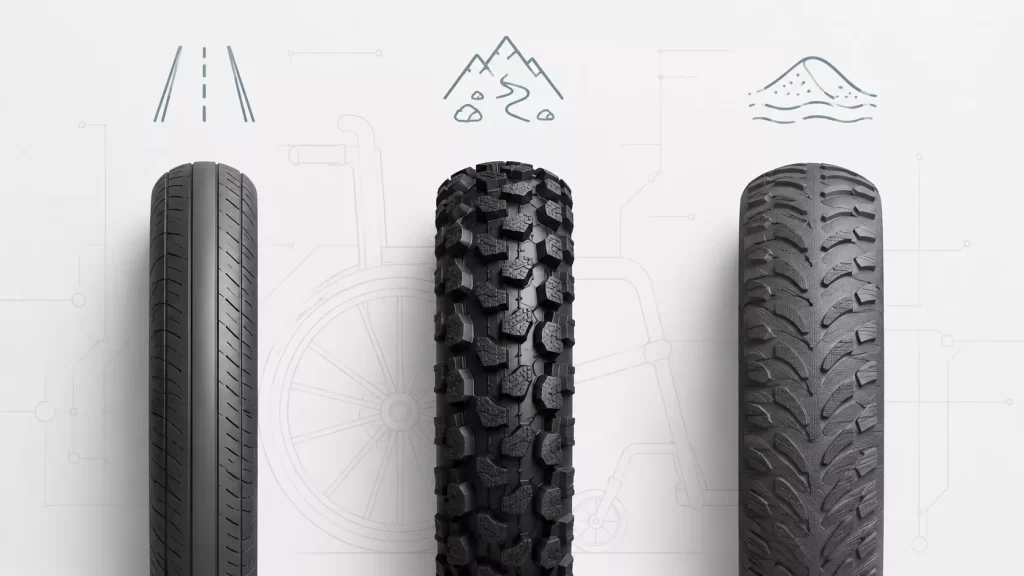
Tread is the part everyone fixates on, but it only does its job once you’ve got the construction and size right. Four broad categories cover the field:
-
Slick / ribbed (smooth, high-pressure). Lowest rolling resistance, fastest and easiest on pavement, minimal grip on anything loose. Right for indoor and mostly-paved users — wrong for trail.
-
Semi-slick (flat center, knobs on the shoulder). A fast-rolling center strip for efficiency on hard ground, with side knobs that bite when you lean into loose corners. The best single-tire compromise for mixed urban-and-trail use. The Kenda Kobra is the archetype.
-
Knobby / aggressive lug. Deep, spaced lugs that dig into mud, grass, sand and snow and shed debris as they roll. Maximum traction off-road; noticeably more rolling resistance and faster wear on pavement. The Kenda Nevegal — a mountain-bike tread that wheelchair users adopt — is a popular example, rated by Kenda for “loose gravel, dirt, sand and grass.”
-
Balloon / fat (wide, very low pressure). Less about tread depth, more about sheer width and softness. These spread your weight over a big footprint so you float instead of sinking. Essential for deep sand and soft snow, where even an aggressive narrow knobby will dig a trench and stop.
The principle underneath all four: on hard ground, traction comes from a smooth tire pressing down; on soft ground, traction comes from a wide tire spreading out and lugs digging in. That’s why a single “best off-road tire” doesn’t exist — it depends entirely on what’s under your wheels.
The terrain-to-tire matching matrix
This is the table to bookmark. Find your dominant surface in the left column and read across. “Width” and “PSI” are starting points for a typical 24-inch manual drive wheel — your exact numbers depend on the tire’s rating and your weight.
|
Your terrain |
Construction |
Tread |
Width / type |
Target pressure |
Example tires |
Watch out for |
|---|---|---|---|---|---|---|
|
Mostly pavement, occasional curb cut |
Pneumatic or foam-filled |
Slick / semi-slick |
Standard (1–1.5″) |
Higher (toward max rating) |
Schwalbe Marathon Plus, Primo Sentinel |
Don’t fit knobbies you don’t need — they’re slower and wear fast |
|
Grass / lawn / sports field |
Pneumatic |
Light knobby or semi-slick |
Standard–wide |
Mid |
Kenda Kobra, Kenda Nevegal |
Wet grass is slick; lower pressure adds bite |
|
Packed dirt trail / hardpack |
Pneumatic |
Semi-slick to knobby |
1.5–2″ |
Mid |
Kenda Nevegal, MTB-derived treads |
Roots and ruts catch narrow casters |
|
Loose gravel |
Pneumatic |
Knobby |
1.75–2.4″ |
Mid–low |
Knobby MTB tires |
Front casters wash out — consider larger front wheels |
|
Mud |
Pneumatic |
Aggressive, widely-spaced knobby (self-cleaning) |
2″+ |
Low |
Mud-specific MTB knobbies |
Clogged tread = no grip; spaced lugs shed better |
|
Sand / beach |
Pneumatic |
Smooth balloon or minimal tread |
Fat / balloon (3–4″+) |
Very low (float) |
Balloon-tire kits (e.g., Wheeleez-type), fat wheel sets |
Narrow knobbies sink — width beats tread here |
|
Snow / ice |
Pneumatic |
Knobby (snow) + soft compound |
Wide–fat |
Low |
Fat/balloon for snow; studded options for ice |
Hard solid tires are dangerous; float and soft rubber grip |
|
Mixed (urban + weekend trail) |
Pneumatic, puncture-protected |
Semi-slick |
1.5–1.75″ |
Mid–high |
Kenda Kobra, Marathon Plus |
One tire can’t be perfect everywhere — pick your priority |
Two patterns jump out. First, sand and snow are about width and low pressure, not aggressive tread — float is the goal. Second, the further you go off-road, the more your front casters become the limiting factor (see fit section below). A great rear tire can’t save you if 6-inch hard casters are spearing into the trail.
Best all-terrain wheelchair tires: a cross-model comparison
These are the workhorses wheelchair users actually run, with real specifications. Sizes shown are common 24-inch manual-chair fitments; most are sold in several sizes, so confirm yours.
|
Model |
Type |
Tread |
Typical size |
Pressure |
Puncture protection |
Best for |
|---|---|---|---|---|---|---|
|
Schwalbe Marathon Plus |
Pneumatic |
Slick/ribbed |
24×1 3/8 (37-540) and more |
~50–85 PSI |
5 mm SmartGuard (excellent) |
Daily paved + light off-road, max flat resistance |
|
Kenda Kobra |
Pneumatic |
Semi-slick (center strip + side knobs) |
24″ MTB sizes |
Mid |
Moderate |
Mixed urban-trail, best all-rounder |
|
Kenda Nevegal |
Pneumatic |
Knobby (MTB) |
24×2.1–2.5″ |
Moderate — per sidewall |
Moderate |
Loose gravel, dirt, grass, sand |
|
Primo Sentinel |
Pneumatic |
Light tread |
24×1 3/8 and more |
Mid–high |
Puncture-resistant layer |
Reliable everyday with occasional off-road |
|
Balloon / fat wheel kits (Wheeleez-type, “fat” wheel sets) |
Pneumatic balloon |
Smooth, very wide |
12.5″ balloon / 3–4″+ wide |
Very low |
n/a (float design) |
Sand, beach, deep snow |
A few buying notes the listicles gloss over:
-
Puncture protection is a spectrum, not a yes/no. The Marathon Plus’s 5 mm layer is the benchmark; lighter “puncture-resistant” tires trade some protection for lower weight and rolling resistance.
-
A knobby tire you run on pavement 90% of the time is the wrong tire. It’s heavier, slower and wears its lugs flat. Match the tire to where you actually spend your miles, not your most adventurous day.
-
Two-set strategy. Many active users keep a fast everyday set and a knobby/fat set, swapping seasonally or for trips. Quick-release wheels make this a five-minute job.
-
Power-chair users: your tires are model-locked. The table above is for manual 24-inch drive wheels. Power chairs run specific drive tires (commonly 10–14″) matched to the motors and suspension — don’t fit a generic tire. Check your manufacturer’s approved tire list, and remember that on hills the limit is usually the drive system, not the tread.
Wheelchair tire sizes explained (and the trap that ruins orders)
More all-terrain tire purchases fail on sizing than on tread choice. Here’s how to get it right.
Wheelchair tires use two labelling systems, and the friendly one lies to you:
-
Fractional / inch sizing: “24 × 1 3/8”, “24 × 1”, “25 × 1”. This is the diameter and width in inches — but the same inch label can hide different real diameters.
-
ISO / ETRTO sizing: a precise two-number code like 37-540, meaning 37 mm wide × 540 mm bead-seat diameter. The second number is the one that must match your wheel.
Here’s the trap: a “24 × 1 3/8” tire can be a 540 mm bead-seat or a 541 mm, and tires labelled “24 × 1 1/8” can be 520 mm or 540 mm — sizes that do not interchange. Order by the inch label alone and you can receive a tire that simply won’t seat on your rim. The bicycle-sizing reference at Sheldon Brown’s tire-sizing page documents exactly this 520/540/541 confusion. The rule: find the ETRTO number printed on your current tire’s sidewall and match that.
Other sizing levers for all-terrain:
-
Going wider, same diameter. A common off-road trick: fit a smaller-diameter rim with a fatter tire so the overall wheel diameter stays the same but you gain width and air volume. This is how people add float without changing the chair’s geometry.
-
Fat and balloon tires (3–4″+ wide, or 12.5″ balloon wheels) live in their own ecosystem — usually sold as complete wheel sets, not bare tires.
-
Drive-wheel diameters run 22″, 24″, 25″ and 26″. The 26″ size is full mountain-bike territory — which is exactly why dedicated off-road chairs use it.
Wider, more aggressive tires add rotating weight, and that effort adds up over a day — the same reason chair frame material matters. If you’re weight-conscious, our guide to aluminum vs carbon fiber vs titanium wheelchair frames explains how the platform under your tires affects total push effort.
Will they fit? Compatibility and installation
A tire can be the right size and still cause problems on your specific chair. Run this checklist before you buy:
-
Bead-seat diameter (ETRTO): must match exactly — see above. This is the make-or-break check.
-
Width clearance: a fatter tire has to clear the side guards, frame and brakes. Many people fit a wider tire only to find it rubs the clothing guard or that the wheel lock no longer reaches the tire. Measure the gap.
-
Wheel-lock / brake re-adjustment: push-to-lock brakes are set to a specific tire diameter and width. Change either and you’ll likely need to re-position the brake.
-
Axle length and spacers: very wide tires or wheel sets can need a longer axle or spacers so the tire clears the frame.
-
Front casters are the hidden bottleneck. Small, hard front casters dive into sand, snag on gravel and stop dead at trail lips. All-terrain capability often depends on fitting larger, softer or pneumatic front casters as much as new rear tires. Upgrading rear tires alone, with stock casters, is the most common off-road disappointment.
-
Center of gravity and tip risk: taller or wider tires subtly change your seat height and balance. Re-check your anti-tip setup after any size change.
If you’re comfortable changing a bicycle tire, swapping a wheelchair pneumatic is the same job — lever the tire off, replace tube or tire, re-inflate to the sidewall-rated pressure. If your chair has quick-release wheels, the whole wheel pops off in seconds, which is what makes a two-set, swap-by-terrain approach practical.
When NOT to switch to all-terrain tires
This is the section the affiliate guides won’t write, because it doesn’t sell tires. Aggressive all-terrain rubber is the wrong choice more often than people think:
-
You’re on pavement most of the time. Knobbies are heavier, slower (higher rolling resistance) and wear their lugs flat on hard surfaces. You’ll push harder every day to buy traction you rarely use.
-
You self-propel and fatigue is a concern. Every gram of rotating weight and every extra ounce of rolling resistance costs you. A lighter, efficient tire may extend your real-world range more than a grippy one.
-
Your problem is ice, not loose ground. Most knobbies don’t grip ice; you need studs or a soft winter compound, not just deep lugs.
-
Snow and sand demand width, not tread. Fitting an aggressive narrow knobby for the beach is a classic mistake — it digs in and sinks. The fix is a fat/balloon tire, which is a wheel-set decision, not a tire swap.
-
Loose clothing or transfers. Deep lugs can catch clothing and make hand-propulsion grippier in a way some users dislike.
For a user whose week is 90% sidewalks and stores with the odd grass verge, the better upgrade is usually a lighter, more efficient everyday chair — not heavier tires. A well-chosen foldable everyday wheelchair on quality semi-slick tires will out-perform a heavy off-road conversion for that life.
Maintenance and care by terrain
Off-road use is harder on tires, and the maintenance is terrain-specific.
-
Check pressure before every outing. Pneumatic tires lose air slowly, and correct PSI is what gives you both efficiency and the controlled “float” you set for soft ground. A cheap gauge pays for itself in push effort.
-
Beach and salt: rinse tires, rims and especially the axle/bearings with fresh water after sand or saltwater. Salt and grit are what kill bearings and corrode hardware.
-
Mud: clear packed mud out of the tread so the lugs can grip again, and check brakes haven’t packed with grit.
-
Inspect for wear: cracks in the sidewall, flattening of the center tread, or knobs worn to nubs mean it’s time to replace. Worn tread on pavement is fine; worn tread on a wet trail is a fall risk.
-
Carry a repair kit off-road. A spare tube, levers and a mini-pump (or sealant) turn a trailhead flat from a rescue call into a ten-minute fix. This is the price of the pneumatic ride — and worth it.
What it costs
-
Replacement all-terrain tires: roughly $40–150 per tire for quality pneumatics — puncture-protected models like the Marathon Plus sit at the upper end, basic tubes and knobbies lower.
-
Tubes, levers, pump/sealant: a small one-time outlay (~$30–60) for a self-service kit.
-
Swap-on fat/balloon wheel sets: a few hundred dollars and up, since you’re buying complete wheels.
-
Dedicated all-terrain chairs: a different tier entirely — purpose-built off-road and beach chairs often run into the thousands.
The cost-effective path for most people is clear: re-tire your existing chair first. Only move to wheel sets or a dedicated chair if your terrain genuinely defeats a good tire — deep sand, soft snow, or true backcountry trail.
Tires vs. a dedicated all-terrain chair
If you’ve read this far and your honest answer is “I’m off-road most of the time,” tires alone won’t get you there. Purpose-built chairs solve problems a tire can’t:
-
Lever-drive off-road chairs like the GRIT Freedom Chair use mountain-bike wheels (26″ rear / 559 mm) and a lever drivetrain so you can power up trails, beaches and snow with far less wrist strain than hand-rimming a converted chair.
-
Three-wheeled carbon chairs (e.g., Trekinetic-style designs) use a single steered front wheel and adjustable camber to track over rough ground.
-
Balloon-tire beach chairs (e.g., Extreme Motus-style) float across sand and shallow water on wide, low-pressure wheels.
These outperform any everyday chair off-road — but they’re heavier, pricier and less convenient on pavement and for transport. For many people the smartest setup is two tools: an everyday folding chair for daily life and transport, plus tires (or a dedicated chair) for the terrain they actually chase.
Choosing with confidence
All-terrain tire selection comes down to a short, honest chain of questions: Where do I actually spend my miles? How much flat-risk and maintenance can I live with? Does my chair — wheels, casters, brakes — accept the tire I want? And is this really a tire problem, or a wheel or chair problem? Answer those in order and the matrix above points straight to your set.
INTCO Medical builds foldable manual and power wheelchairs on standard wheel platforms that are easy to live with and easy to re-tire as your terrain changes. If you’re weighing the right everyday chair to pair with a tire upgrade — or you’re not sure whether your goal calls for new tires, new wheels or a different chair — get in touch with our team and we’ll help you match the equipment to where you want to go.
Pressure, sizing and fit figures in this guide are general starting points drawn from manufacturer specifications (Schwalbe, Kenda, Primo), the ISO/ETRTO sizing standard, and published rolling-resistance research. Always confirm the exact pressure and size against your tire’s sidewall and your chair’s specifications, and consult your supplier or clinician for advice specific to your needs.
Frequently asked questions
What are the best wheelchair tires for grass?
A light knobby or semi-slick pneumatic at moderate pressure. Tires like the Kenda Kobra (semi-slick) or Kenda Nevegal (knobby) bite into turf; drop the pressure a little for wet grass to add grip.
Solid or pneumatic tires for off-road — which is better?
Pneumatic, clearly. Air tires cushion impacts, run at low pressure for float, and (per recent research) can actually roll with less resistance than solid polyurethane. Solid tires are flat-free but ride harshly and dig into soft ground. If flats worry you, choose a puncture-protected pneumatic or a foam-filled tire instead of going solid.
What PSI should all-terrain wheelchair tires run?
It depends on the tire and terrain. Run toward the sidewall’s maximum for efficiency on pavement and hard ground; drop pressure for grip and float on sand, snow and mud. Always stay within the printed range on the sidewall.
Can I put mountain-bike tires on my wheelchair?
Often yes — many “all-terrain wheelchair tires” are MTB treads (the Kenda Nevegal, for example). The requirement is size: the tire’s ETRTO bead-seat diameter must match your wheel, and it has to clear your frame, side guards and brakes.
What’s the difference between all-terrain tires and a fat-tire wheelchair?
All-terrain tires fit your existing wheels for trail, gravel and grass. A fat-tire (balloon) setup uses very wide, low-pressure wheels — usually a complete wheel set — for the float you need in deep sand and soft snow. They solve different problems.
Do I need to upgrade my front casters too?
Frequently, yes. Small hard casters are the most common reason a rear-tire upgrade disappoints off-road. Larger, softer or pneumatic casters keep the front of the chair from diving into soft or uneven ground.