


Contact Us
How to Get a Wheelchair Parking Permit: Global Guide
A wheelchair parking permit is one of the most practical things you can do to make daily life easier. It lets you park in wider, closer spaces — the difference between a manageable trip to the pharmacy and one that is exhausting before you even get inside.
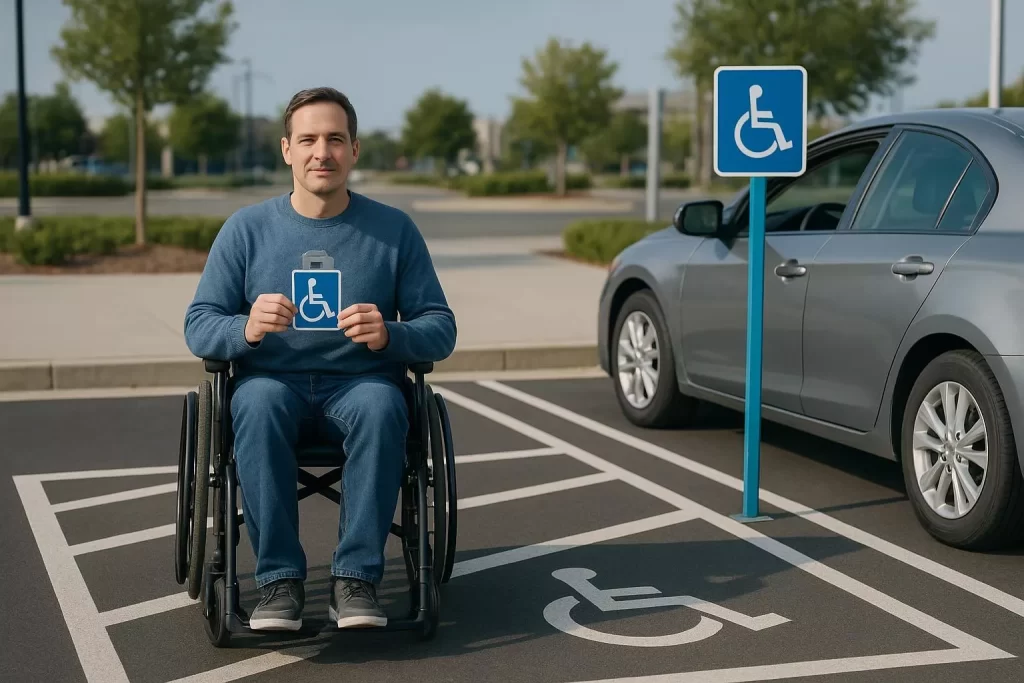
Yet the process confuses many people, mostly because the names and rules change from country to country. A “placard” in the United States is a “Blue Badge” in the United Kingdom and a “Mobility Parking Scheme permit” in Australia. The good news: underneath the different labels, the path to getting one is almost identical everywhere.
This guide walks you through the universal five-step process, shows you exactly how it works in the US, UK, Canada, Australia and the EU, and covers the questions most other guides skip — like whether your permit works when you travel abroad.
Quick takeaways
The process is the same worldwide: confirm eligibility → get the form → get medical certification → submit → receive your permit.
Eligibility is usually based on how far you can walk, not a specific diagnosis. Wheelchair and mobility-aid users almost always qualify.
Permits are often free or low-cost, and processing typically takes 2 to 12 weeks.
Permits come in temporary and permanent types, as a hangtag placard, license plate, or badge.
Always confirm the details with your local issuing authority — rules vary by state, province and country.
What is a wheelchair parking permit?
A wheelchair parking permit — more formally a disabled or accessible parking permit — is an official authorization that lets a person with a qualifying mobility condition use designated accessible parking spaces. These spaces are wider, closer to entrances, and reserved by law. Crucially for wheelchair and scooter users, many include a striped access aisle beside the bay — the clear space you need to lower a ramp, swing the door fully open, or transfer to your chair. Some markets also designate extra-wide van-accessible spaces for vehicles with side or rear lifts.
Depending on where you live, the permit takes one of a few forms:
-
A hangtag placard that hangs from your rear-view mirror and moves with you between vehicles (most common in the US and Canada).
-
A disabled license plate attached to one specific vehicle.
-
A badge or card displayed on the dashboard (the UK Blue Badge, the EU parking card, Australia’s MPS card).
It is worth knowing the distinction between a placard and a license plate: a placard travels with you — useful if you ride in different cars, taxis or with family — while a disabled plate is tied to one vehicle. Many people who drive their own car choose a placard for the flexibility, or hold both.
Permits also come in two durations:
-
Temporary permits — for short-term conditions such as recovery from surgery or an injury. Typically valid from a few months up to a year, and renewable while the condition lasts.
-
Permanent permits — for long-term or permanent mobility impairments. Valid for a number of years before renewal — commonly three to five, depending on the country (a UK Blue Badge, for example, lasts up to 3 years).
Do you qualify? Eligibility criteria
Most authorities base eligibility on functional mobility rather than a named diagnosis. The most common standard is the inability to walk a short distance without stopping to rest — phrased as about 200 feet (≈60 metres) in the US, and as roughly 50–100 metres in the UK and Australia.
You will generally qualify if one or more of the following applies:
-
You use a wheelchair, scooter, walker, cane, crutches or braces to get around.
-
You cannot walk a short distance (around 200 ft / 60 m, or 50–100 m in some countries) without stopping to rest.
-
You have a neurological, arthritic or orthopaedic condition that severely limits walking.
-
You have a lung condition that severely limits breathing, or you use portable oxygen.
-
You have a cardiac condition that significantly limits mobility.
-
You are legally blind.
-
You have lost the use of one or both legs, or have a permanent condition that severely limits walking.
A growing number of jurisdictions (including the UK) also recognise non-visible or “hidden” disabilities — such as certain cognitive, neurological or mental-health conditions — so it’s worth checking even if your condition isn’t obviously mobility-related.
Because you are a wheelchair or mobility-aid user, you almost certainly meet the threshold — but a licensed healthcare professional still has to certify it on your application (see Step 3). You can also apply on behalf of a dependent — a child or an adult in your care — under most schemes. The exact wording differs by jurisdiction, so check the criteria from your own issuing authority before you apply.
The universal 5-step process
Wherever you live, getting a wheelchair parking permit follows the same five steps. The labels on the forms change; the sequence does not.
Step 1 — Confirm eligibility and gather your documents
Check your local eligibility rules (above) and collect what you will need: proof of identity (driver’s licence, ID card or passport), proof of address, sometimes a passport-style photo, and your vehicle details if you are applying for a disabled plate. Knowing this up front prevents a rejected or delayed application.
Step 2 — Get the official application form
Download the form from your issuing authority’s official website, or pick one up in person. This is almost always a government body:
-
US — your state’s Department of Motor Vehicles (DMV).
-
UK — your local council, applied for through GOV.UK.
-
Canada — your provincial service office (e.g. ServiceOntario).
-
Australia — your state transport authority (e.g. Service NSW / Transport for NSW).
Use the official source only. Many third-party sites offer to “process” permits for a fee — they cannot grant you anything the government doesn’t, and they are not required.
Step 3 — Get medical certification
A licensed healthcare professional — usually a doctor, but in some places a nurse practitioner, physician assistant, optometrist or physiotherapist — must complete and sign the medical section of your form, confirming your qualifying condition. As a wheelchair user, this is typically straightforward; bring the form to a routine appointment. Some authorities accept certification from a clinician already on record for you.
Step 4 — Submit your application
Send the completed, signed form to your issuing authority by the method they allow — online, by mail, or in person. Pay any fee at this stage (many jurisdictions charge nothing). Keep a copy of everything you submit.
Step 5 — Receive and display your permit
Processing usually takes 2 to 12 weeks depending on the country and method. Once it arrives, display it correctly — hang the placard from the mirror when parked (remove it while driving), or place the badge/card face-up on the dashboard. Note the expiry date so you can renew on time.
Country-by-country snapshot
The framework above is universal, but the authority, cost and timing differ. Here is how it looks in five major regions. Always click through to the official source for the current details.
|
Region |
What it’s called |
Issuing authority |
Typical cost |
Processing time |
Official source |
|---|---|---|---|---|---|
|
United States |
Disabled Person Parking Placard / Plate |
State DMV |
Often free (placard) |
~2–4 weeks |
|
|
United Kingdom |
Blue Badge |
Local council via GOV.UK |
Up to £10 (England); free in Scotland & Wales |
Up to ~12 weeks |
|
|
Canada |
Accessible Parking Permit (APP) |
Provincial office (e.g. ServiceOntario) |
Free (Ontario) |
A few weeks |
|
|
Australia |
Mobility Parking Scheme (MPS) permit |
State transport authority |
Free (NSW) |
A few weeks |
|
|
European Union |
EU parking card / national disability badge |
National authority of each country |
Varies by country |
Varies |
In the US, rules are set at the state level, so the form, fee and validity period vary from one state to the next — but the five steps and the medical-certification requirement are consistent across all of them.
How much does it cost, and how long does it take?
For most people, a wheelchair parking permit is inexpensive or free. Many US states issue placards at no charge; the UK caps the Blue Badge fee at £10 in England and waives it in Scotland and Wales; Ontario and NSW issue theirs free of charge.
Processing time ranges from about two weeks to three months. Applying online and submitting a complete, correctly certified form is the fastest route. If you have a temporary condition and need the permit quickly, ask your authority whether expedited or in-person same-day options exist.
Using your permit in another state or country
This is the part most guides leave out — and it matters if you travel.
-
Within the US: Disabled placards and plates are generally recognized across all states thanks to reciprocity. Your home-state placard lets you use accessible spaces when you visit another state, though you must still follow that state’s specific parking rules.
-
Within the EU: The EU parking card is built on mutual recognition — a card issued in one member state is honoured in the others, so you can park under local rules wherever you travel in the EU. The official EU parking card page explains how it works.
-
UK Blue Badge abroad: A Blue Badge can be used in some European countries, but recognition is not guaranteed everywhere post-Brexit. Check the rules for your destination before relying on it.
-
The ECMT scheme: Many European countries (and several beyond the EU) take part in a long-standing reciprocal arrangement originating from the European Conference of Ministers of Transport, under which a recognised disability parking card is honoured across participating countries — useful when you travel beyond the EU’s own mutual-recognition rules.
-
Travelling further afield: Outside reciprocity schemes, your home permit may not be valid. Where it isn’t, look into a temporary or visitor’s permit from the place you are visiting — Canada, for example, offers a traveller’s permit.
The safe rule: never assume. Confirm recognition with the destination’s transport authority before your trip, and carry your permit and supporting documents with you.
Renewing or replacing your permit
Permits expire, so plan ahead:
-
Renewal — Most authorities send a reminder before expiry, but the responsibility is yours. Permanent permits often renew with minimal paperwork; temporary ones usually require fresh medical recertification. Renew a few weeks early to avoid a gap.
-
Lost, stolen or damaged — Report it to your issuing authority and request a replacement. Many offer this online for a small fee or free. Report a stolen placard promptly, as misuse of disabled parking is taken seriously.
-
Change of details — If you move or change vehicles, update your records so your permit stays valid.
Rules of use — and the penalties for getting it wrong
A wheelchair parking permit is personal to the permit holder. The core rules are consistent worldwide:
-
The permit may only be used when the holder is in the vehicle, as driver or passenger.
-
It is not for friends or family to use to grab a convenient space when the holder isn’t present.
-
Display it correctly — visible, face-up, and removed from the mirror while driving.
-
Don’t park where it’s still prohibited (fire lanes, loading zones, blocked access aisles).
Misuse — using someone else’s permit, copying one, or parking in accessible spaces without one — carries penalties that vary widely by jurisdiction, often fines from roughly US$100 to US$1,000 or more, plus permit cancellation and, in some places, vehicle towing. These spaces exist so that wheelchair users can actually get in and out of their vehicle; protecting them protects everyone who depends on them.
Making the most of your permit: parking is only half the equation
A parking permit gets you the space. What turns that space into genuine independence is a mobility aid you can actually get in and out of a vehicle on your own — or with minimal help.
A closer, wider parking spot loses much of its value if loading your wheelchair is a two-person job. This is where a lightweight, foldable design makes the practical difference. Modern lightweight and foldable wheelchairs fold compactly enough to lift into a car trunk; a foldable manual chair like the DOLY weighs around 10–12 kg and collapses to a slim profile, while a carbon-fibre power chair such as the E-LITE keeps the weight near 13.5 kg for travel.
If you’re weighing your options, it helps to understand what actually drives a chair’s weight and durability — our guide to wheelchair frame materials: aluminum vs. carbon fiber vs. titanium breaks down the trade-offs so your permit and your wheelchair work together.
The bottom line
Getting a wheelchair parking permit comes down to the same five steps almost everywhere: confirm your eligibility, get the official form, obtain medical certification, submit your application, and display your permit correctly. The terminology and the office you deal with change with your country, but the path doesn’t — and for most wheelchair users, qualifying is straightforward and the permit is free or inexpensive.
Start at your local issuing authority’s official website, gather your documents, and book a quick appointment for the medical certification. Within a few weeks, parking closer and with room to manoeuvre becomes one less thing to worry about.
This article is general guidance, not legal advice. Parking permit rules vary by jurisdiction and change over time — always confirm current requirements with your official local issuing authority.
Frequently asked questions
Who qualifies for a wheelchair parking permit?
Anyone with a qualifying mobility condition — typically the inability to walk a set distance (often ~200 ft / 50 m) without rest, use of a wheelchair, scooter or walker, severe respiratory or cardiac limitations, or legal blindness. A licensed healthcare professional must certify it.
Do I need a doctor’s note?
Yes. Almost every authority requires a licensed clinician to complete the medical section of your application. In some cases an existing clinical record on file can satisfy this.
How long does it take to get one?
Usually 2 to 12 weeks, depending on the country and whether you apply online, by mail or in person. Complete, correctly certified applications process fastest.
How much does it cost?
Often free or low-cost — many US states and Canadian provinces charge nothing; the UK Blue Badge is up to £10 in England and free in Scotland and Wales.
What’s the difference between a placard and disabled plates?
A placard travels with you and can be used in any vehicle you ride in; disabled plates are attached to one specific vehicle. Many drivers choose a placard for flexibility.
Can I use my permit in another state or country?
Within the US, placards are generally recognized across states. The EU parking card is mutually recognized across member states. Beyond reciprocity schemes, recognition isn’t guaranteed — check with the destination authority and consider a visitor’s permit.
Can a family member use my permit when I’m not in the car?
No. The permit is personal to the holder and may only be used when the holder is travelling in the vehicle. Misuse can lead to fines and cancellation.
How do I renew or replace a lost permit?
Renew through your issuing authority before the expiry date — permanent permits often need little paperwork, temporary ones usually need recertification. For a lost or stolen permit, report it and request a replacement, frequently available online.