


Contact Us
Power Wheelchair Hill Climbing: Slope Limits & Test Proof
Procurement teams get a predictable version of this question every buying cycle: Can a power wheelchair climb hills?
The honest answer is yes—within a defined limit. But the usable limit is model-specific, and the risk isn’t just “will it make it up.” The bigger risk is control on the way down, braking consistency, stability under load, and what happens when users turn or hit a surface change.
This article gives you a practical, spec-driven way to evaluate hill performance using real slope-test evidence—plus an example of how a manufacturer (INTCO Medical) documents and verifies incline behavior through ramp testing.
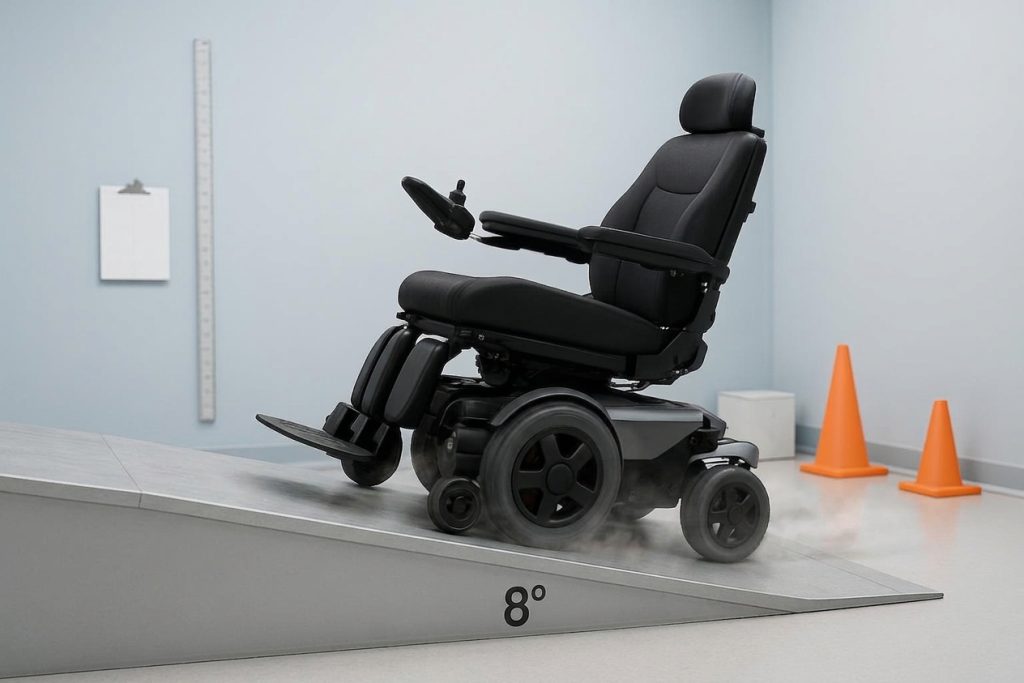
Start with the baseline: ramps are measured in grade, and the benchmark is 1:12
Before you compare products, align on what “steep” means.
-
Percent grade describes rise over run (e.g., 8.33% means 8.33 units up for every 100 units forward).
-
Degrees describe the ramp angle.
For public-access environments in the U.S., the most common reference point is the ADA ramp guideline. The U.S. Access Board’s ADA ramp guidance (1:12 / 8.33%) sets a maximum running slope of 1:12 for ramps in new construction.
In procurement discussions, you’ll often hear this referenced as the ADA ramp slope 1:12 baseline.
That benchmark doesn’t tell you what a specific power wheelchair can do—but it’s a useful environmental expectation: if you’re sourcing for hospitals, senior living, and rehab settings, your equipment should behave predictably on common accessible routes.
Why power wheelchair hill climbing is a safety question, not a marketing question
Hill climbing is limited by multiple interacting factors. If you evaluate only one (like motor power), you can end up with a chair that “climbs” but doesn’t control well—or doesn’t do so consistently across users and surfaces.
Stability: center of gravity and tip risk
On an incline, weight shifts. Add seat elevation, tilt, bags, oxygen tanks, or an atypical user posture, and stability margins change.
From a procurement standpoint, you want to know:
-
What configurations were tested?
-
Was the chair tested at rated capacity?
-
Were anti-tip features used (and if so, are they standard or optional)?
Traction: surface conditions are the hidden variable
A chair that tracks well on a clean test ramp can behave differently on wet concrete, textured outdoor ramps, or transitions between surfaces.
Ask suppliers how hill performance changes with:
-
tire type
-
tread condition
-
indoor vs outdoor surfaces
-
wet conditions
Braking and downhill control: the most common failure mode
In real-world use, controlled descent matters as much as ascent. Inability to maintain speed, stop predictably, or prevent rollback is where incident risk concentrates—in other words, wheelchair braking on slope is often the practical limiter, not raw motor power.
⚠️ Warning: A chair that can physically climb an incline is not automatically safe on that same incline. Procurement should prioritize controlled braking and predictable tracking over “maximum incline” claims.
Drive configuration and tracking
Drive layout (front-, mid-, rear-wheel) influences turning behavior and traction distribution on slopes. You don’t need to adjudicate which drive type is “best,” but you do need a vendor to show tracking stability under your expected conditions.
Power wheelchair incline rating: how to read it like procurement
Manufacturers often publish a maximum incline value in the specs, but the value is only meaningful with context.
A good spec sheet makes it clear:
-
whether the rating is continuous or a short-duration test
-
the assumed payload (user weight + accessories)
-
whether the value applies to ascent, descent, or both
-
whether the rating assumes a straight path (no turning)
For example, WHILL lists a model-specific spec: WHILL Model C2 specifications (Maximum Incline: 10°) in its performance table.
Use this kind of statement as a starting point—not the conclusion.
Throughout this article, when we say power wheelchair hill climbing, we mean climb + controlled descent + stop/hold/restart within a defined incline range—not a one-time climb on a perfect surface.
Wheelchair slope test: a procurement-ready framework you can request
If you want a “real slope test” that’s procurement-ready, request evidence in a structured way. Your goal is to confirm three things:
-
Capability: the chair can climb and descend the slopes your customers actually encounter.
-
Control: it can stop, hold, and restart without unsafe behavior.
-
Consistency: performance is repeatable across units and production batches.
What to ask for (minimum viable verification pack)
-
Test method description (slope angle/grade, ramp surface, run length)
-
Payload used (test dummy or rider weight; accessories included)
-
Battery state during test
-
Speed mode used
-
Pass/fail criteria (what counts as a failure)
-
Results format (video is helpful, but documentation matters)
Deal-breaker red flags
-
“It climbs hills easily” with no slope value, no method, no criteria.
-
A slope value provided with no statement about braking/holding.
-
Testing that avoids realistic conditions (e.g., only a short ramp with no stop/restart).
-
No clarity on whether results are representative of mass production (batch QA).
INTCO Medical’s ramp test example: what the slope test is designed to catch
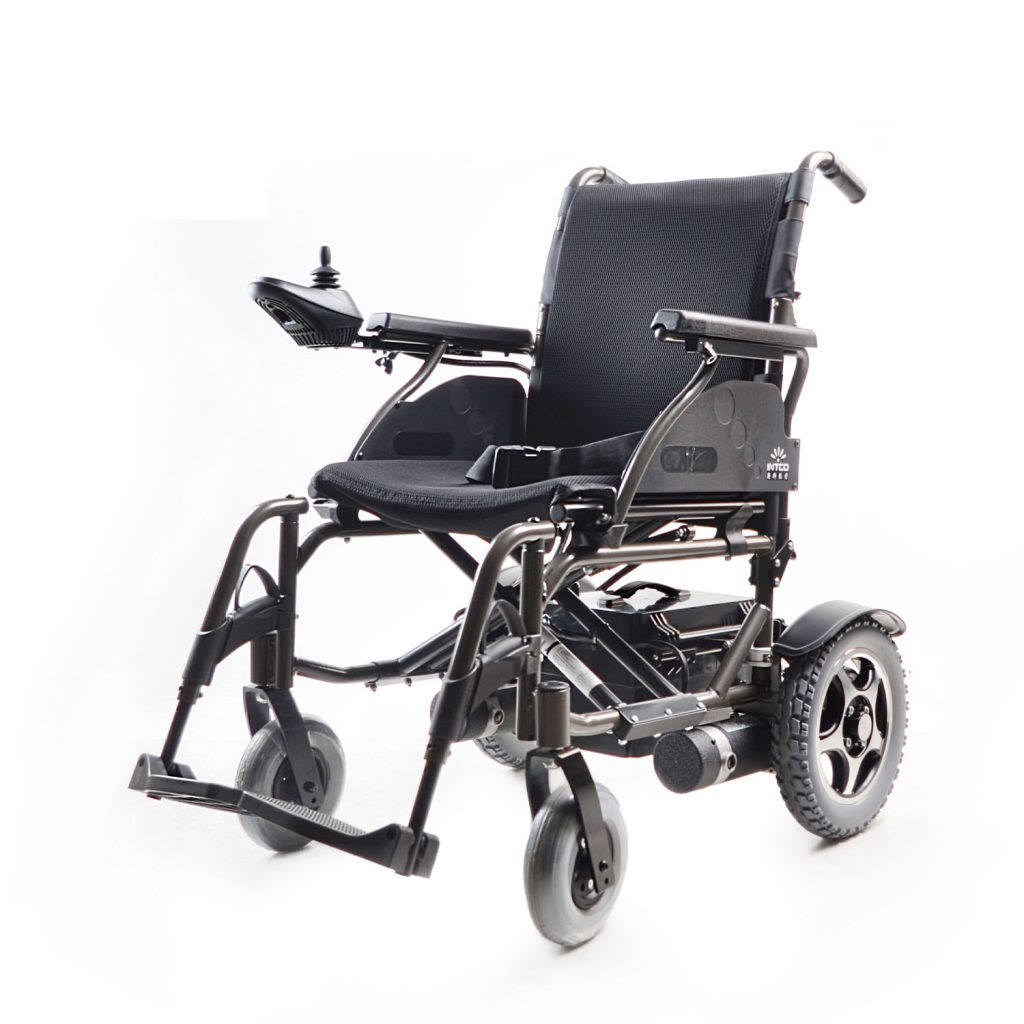
INTCO Medical publishes a verification and testing overview that includes a defined ramp test for every wheelchair.
According to the INTCO Medical verification and testing system, every wheelchair goes through a climbing test on a slope of 8–9 degrees designed to validate:
-
motor power sufficiency
-
deviation on uphill slopes
-
braking sufficiency on slopes
What matters for procurement is not only the slope number, but the intent: the test is explicitly designed to detect real failure modes you should care about during supplier qualification.
Why this matters for sourcing (OEM/ODM and distribution)
If you’re supplying to healthcare and senior-care channels, your downstream costs show up as:
-
returns and warranty exposure
-
service tickets related to braking, tracking, and control
-
reputational risk (especially when incidents occur on ramps)
A slope test that checks both climbing and braking behavior helps you reduce those risks—provided the test method is documented and tied into your broader QA system.
The slope test should not live alone: surrounding verification matters
The same INTCO testing overview describes additional tests that procurement can use as QA signals:
-
Silent room testing includes an internal requirement of less than 60 dB in driving noise (with national standard referenced as below 65 dB) on the manufacturer’s page.
-
A fatigue test describes 6666 consecutive drops at 5 cm and load testing with 136 kg and 150 kg, with a pass expectation of no part detachment or frame fractures.
If you’re evaluating multiple suppliers, this is the kind of structured evidence that helps separate a marketing claim from a quality system.
For a broader view of supplier-side QC considerations, INTCO also outlines process framing in its article on how wheelchair suppliers guarantee product quality.
And for compliance documentation framing, see how INTCO electric wheelchairs meet international quality expectations.
How to translate slope-test evidence into a buying decision
Once you have a slope value and method, translate it into your practical sourcing requirements:
-
Match to environments: map typical customer environments (facility ramps, parking transitions, curb cuts, outdoor grades).
-
Define the safety envelope: require controlled stop/hold/restart on a defined slope.
-
Confirm configuration limits: seat settings, accessories, payload.
-
Ask for documentation: verification reports and quality records that support repeatability.
If you’re building a portfolio that spans manual and electric models, it can help to keep the evaluation consistent across categories. INTCO’s electric vs manual wheelchairs bulk procurement guide provides a useful way to frame channel fit and selection criteria.
Next step: request a verification summary pack
If you’re qualifying OEM/ODM suppliers, ask for a short verification summary that includes ramp testing (slope + braking checks), fatigue testing, and noise criteria—along with the supporting quality documentation.
For INTCO Medical, start with its published verification overview and then request the model-specific documentation that matches your target markets and configurations.
FAQ
Can a power wheelchair climb a steep hill?
Some models can handle steeper grades than others, but “steep” needs a number. Treat any claim as incomplete unless it includes a power wheelchair incline rating (maximum incline) and a test method.
Is an ADA ramp slope the same as a wheelchair’s maximum incline?
No. ADA ramp guidance describes built-environment accessibility requirements, not the limits of a specific chair. It’s best used as a baseline for typical public ramps, not a performance ceiling.
What’s the simplest way to verify hill performance during sourcing?
Ask for a ramp test description with slope value, payload, battery level, speed mode, and pass/fail criteria. Then confirm braking/holding behavior—not just “it climbed.” That’s the difference between a marketing claim and a usable wheelchair slope test.