


Contact Us
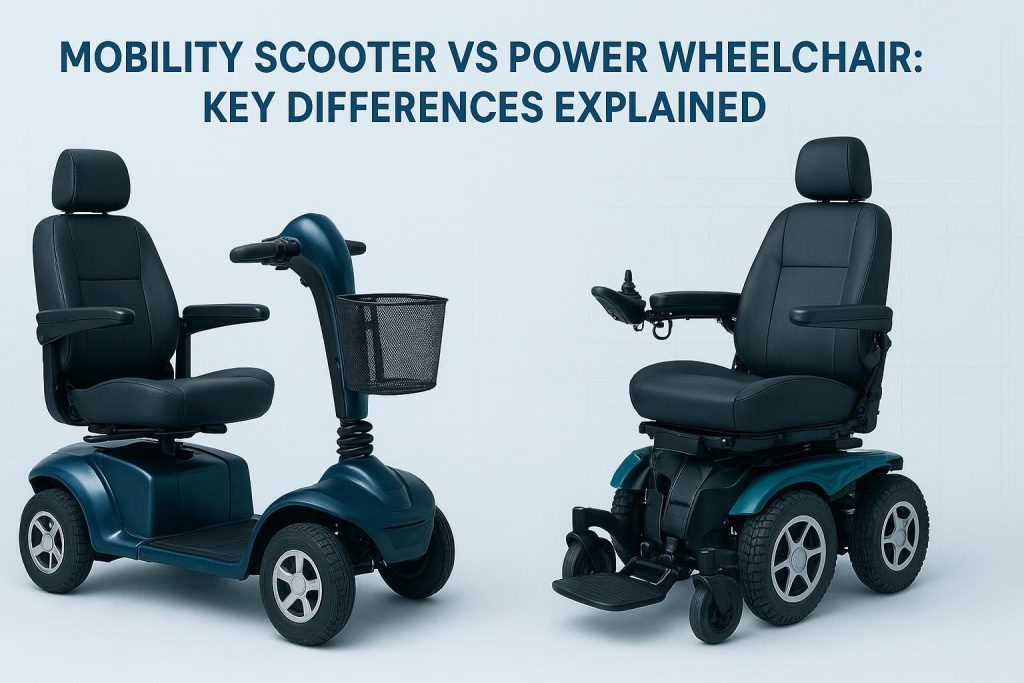
Mobility Scooter vs Power Wheelchair: Key Differences Explained
If you’re comparing a mobility scooter and a power wheelchair, you’re usually trying to answer one practical question:
Which device fits the user’s body, environment, and daily routine with the lowest risk?
That’s true for end users—but it’s also the right framing for procurement teams. The “right” choice isn’t about which category is better. It’s about which category is safer, more controllable, and easier to support for the target user group and the places they’ll use it.
This guide explains the difference, then ends with a sourcing checklist you can use when evaluating OEM/ODM suppliers.
Mobility scooter vs power wheelchair at a glance
|
Evaluation criterion |
Mobility scooter (typical) |
Power wheelchair (typical) |
|---|---|---|
|
Steering & controls |
Tiller/handlebar steering; needs more arm/hand control |
Joystick/adaptive controls; can suit lower strength/dexterity |
|
Turning radius |
Usually wider; prefers open space |
Usually tighter; stronger for indoor maneuvering |
|
Best environment |
Outdoor paths, longer trips, open areas |
Indoors/tight spaces; also outdoors depending on build |
|
Seating & positioning |
Basic seating; limited postural support |
More options for seating, positioning, and support |
|
Transportability |
Often disassembles/folds more easily |
Often heavier; some folding models exist |
Key Takeaway: If indoor maneuverability and postural support are the priority, power wheelchairs usually win. If outdoor distance and easier transport are the priority, scooters often win.
Steering and user control: tiller vs joystick
This is one of the fastest ways to separate “fits the user” from “looks good on paper.”
-
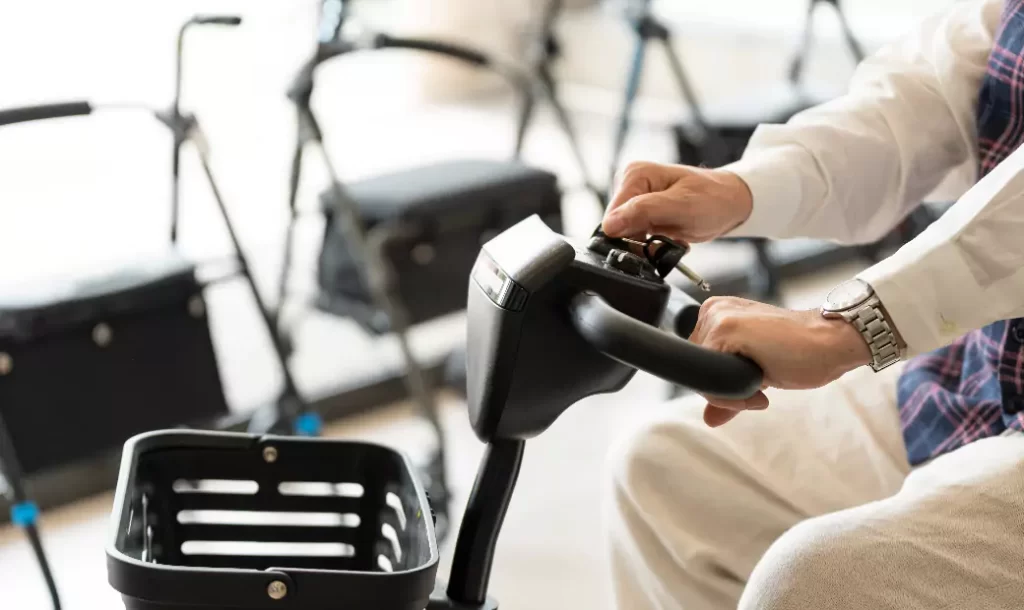
Mobility scooters are commonly controlled with a tiller/handlebar setup. That tends to work best when the user can sit upright, steer with both hands, and make controlled turns.
-
Power wheelchairs commonly use joystick controls (and can support alternative controls depending on the model). This can reduce the physical demand of steering and make precise movement easier.
A practical buying implication: when a user’s upper-body strength, grip, or coordination is limited, a power wheelchair category is often the more forgiving match. One clear consumer-friendly overview is WHILL’s comparison of electric wheelchairs vs mobility scooters.
Maneuverability and turning radius: where the device will actually live
Indoor fit is where “scooter vs power chair differences” show up quickly.
Power wheelchairs are typically built for tight turns in hallways, bedrooms, kitchens, and elevators. Mobility scooters typically need more space to turn—fine outdoors, frustrating indoors.
A maneuverability-focused explanation is available from 1800Wheelchair in its article on power wheelchairs vs mobility scooters for indoor suitability.
Indoor vs outdoor use: distance, terrain, and stability
A simple rule of thumb:
-
Scooters tend to be selected for outdoor mobility—sidewalks, shopping trips, longer distances.
-
Power wheelchairs tend to be selected for indoor mobility and for users who need more continuous support.
That doesn’t mean power wheelchairs can’t be used outdoors, or that scooters can’t be used indoors. It means the default design priority is different.
Seating and postural support: when the chair is a support system
For many users, a power wheelchair isn’t just transportation—it’s where they spend much of the day. That’s why power wheelchairs often have stronger options for seating, positioning, and support.
By contrast, scooters often prioritize simple, comfortable seating for shorter durations.
Portability, storage, and vehicle transport
Portability is rarely about “can it fold.” It’s about whether a real person can move it repeatedly without damage.
-
Many scooters are designed to disassemble or fold more conveniently for transport.
-
Many power wheelchairs are heavier—though some modern folding power chairs exist.
As a concrete example of a folding-style power wheelchair within INTCO’s lineup, the E-LITE folding power wheelchair is positioned as a compact, travel-friendly design.
Public space considerations in the US
Public-space policies vary by facility and context. In the US, the Department of Justice provides assessment factors for “other power-driven mobility devices” (OPDMDs)—including device size, weight, speed, facility conditions, and pedestrian traffic—in its ADA guidance on OPDMDs.
For brands, this matters because it affects labeling, user instructions, and safe-operation guidance.
OEM/ODM sourcing checklist (how to choose mobility scooter or power wheelchair at the supplier level)
If you’re a brand procurement lead, “mobility scooter vs power wheelchair” is only half the story.
The other half is: Can your supplier prove they can build the device consistently—at volume—under change control—without surprises?
Here’s a procurement-ready checklist you can use across both categories.
Quality system and audit readiness
-
ISO 13485 certification scope and validity
-
Documented incoming inspection + supplier qualification
-
Nonconformance handling and CAPA workflow
Safety and performance testing alignment
Even if you don’t cite every test in marketing, your sourcing team should understand what standards your products align to.
-
ISO provides scope information for ISO 7176-14 power and control systems (2022), which covers electrically powered wheelchairs and scooters.
-
The FDA maintains a database of recognized consensus standards; for example, it lists ISO 7176-1 (wheelchair stability) as a recognized standard.
Pro Tip: Ask for the actual test reports and confirm the tested configuration matches what you plan to sell (battery, motor, tire, seat, and controller changes can matter).
Traceability and change control
Request:
-
batch traceability approach for key components (especially electronics and batteries)
-
change notification process (what triggers notice, how long you get, what re-validation is required)
-
spare parts continuity plan and end-of-life policy
Documentation pack (make it easy to say “yes”)
The best suppliers don’t just manufacture—they make procurement easier with a clean documentation pack:
-
certifications + scope statements
-
test report list (and which configuration each report covers)
-
change control overview
-
traceability summary
-
warranty and service parts policy
Where INTCO Medical fits (brand mention)
INTCO Medical manufactures both categories—see its catalog of INTCO mobility scooters and its product lines on the INTCO Medical company page.
For procurement teams that want auditable signals, INTCO summarizes its certification positioning (including FDA 510(k), EN ISO 13485, CE, and SGS) in “How INTCO Electric Wheelchairs Meet International Quality Expectations”.

CTA: Request an OEM/ODM documentation pack
If you’re evaluating suppliers for scooters or power wheelchairs, request a documentation pack (certification scope, test report list, change control summary, and traceability approach) and align on your target markets and configuration before sampling.
FAQ
Is “power wheelchair vs mobility scooter” the same decision as “mobility scooter vs electric wheelchair”?
Most of the time, yes. In many buyer conversations, “electric wheelchair” refers to the power wheelchair category (typically joystick controlled), while scooters use a tiller/handlebar steering design.
What’s better for indoor use: scooter or power wheelchair?
Power wheelchairs are typically better indoors because they’re designed for tighter turning and precision movement.
What should a brand request from an OEM/ODM supplier?
At minimum: quality system evidence (e.g., ISO 13485), test reports aligned to relevant standards, traceability and change control documentation, and a clear spare parts policy.
Do US public spaces allow scooters and power wheelchairs?
Policies vary by facility and context. The ADA provides general assessment factors for OPDMDs in its guidance linked above.
CTA: Start a supplier evaluation conversation
If you’re building (or refreshing) a mobility lineup, start with your target user profiles and environments, then map the device category and the evidence package you need for each target market. That keeps the product decision and the supplier decision aligned from day one.